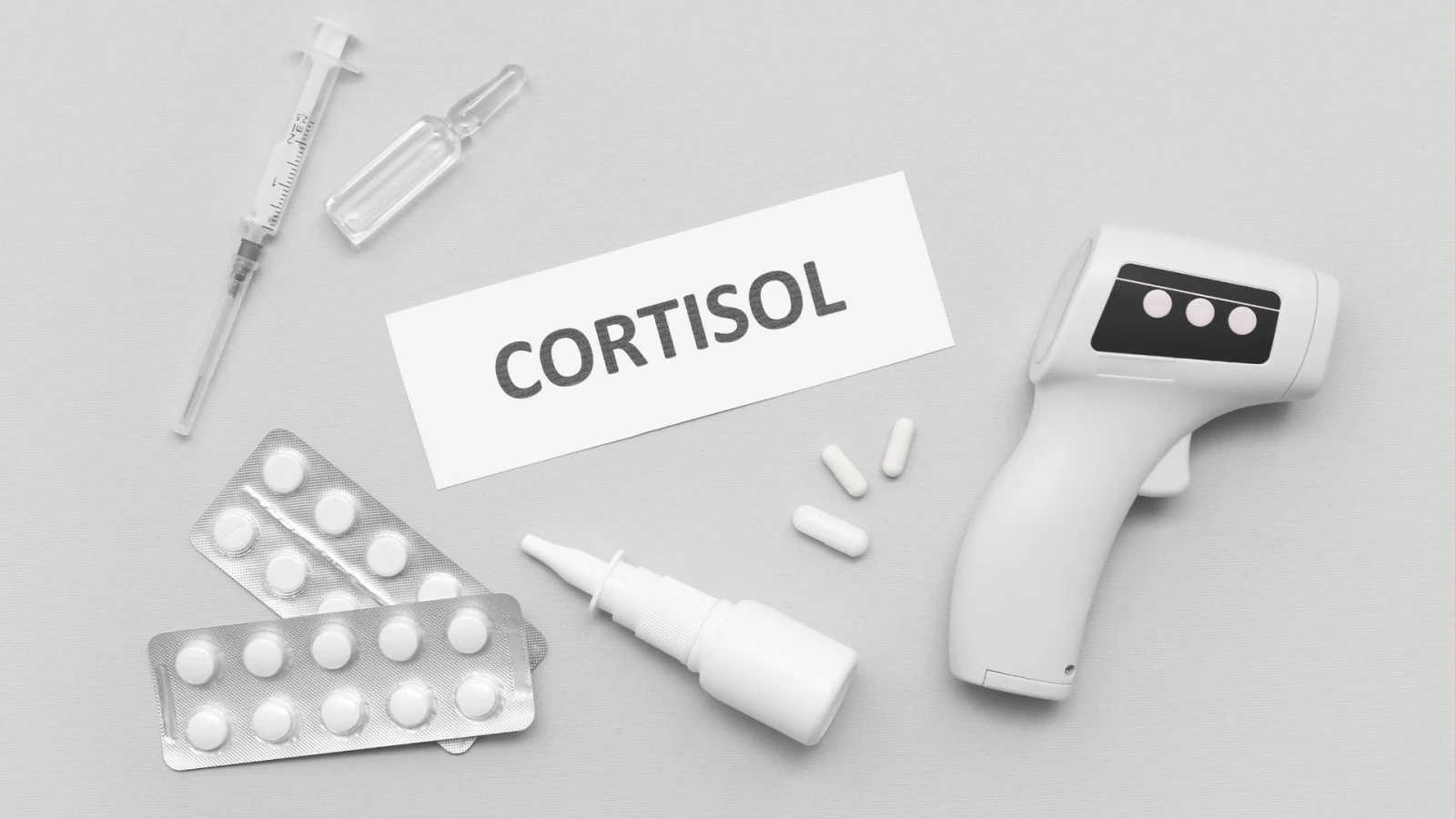
Over the last few weeks my phone has received two remarkably similar messages: “Alex, do I have cortisol face?” Sometimes with a selfie, sometimes without, but the same worry behind it. When I looked up how big the trend actually is, even I was surprised: the cortisol detox hashtag alone has an estimated 800 million views on TikTok. That’s more than the populations of the USA and Germany combined clicking on a video that, at its core, sells a single claim: you can detox your stress hormone.
That claim isn’t true. But simply dismissing it wouldn’t do justice to the genuinely interesting story behind it. Because between “complete nonsense” and “there’s something to it” lies real, partly surprising science. Let’s take a calm look at it.
What cortisol actually is
Cortisol is a steroid hormone produced by your adrenal cortex, controlled by a chain called the HPA axis: the hypothalamus sends a signal, the pituitary passes it on, the adrenal gland releases cortisol. This hormone regulates your blood sugar, your blood pressure, inflammatory processes and your stress response. It also follows a robust 24-hour rhythm: shortly after waking it rises sharply, a phenomenon researchers call the cortisol awakening response, and then falls over the day to a low point during sleep.
The crucial point: cortisol isn’t a toxin. It’s a hormone you need to survive. People whose adrenal glands produce too little cortisol have to replace it as medication for life; without it, things would become life-threatening. “Detoxing” a hormone that your body constantly produces and needs makes about as much sense as trying to “dehydrate” your blood. So the term cortisol detox isn’t just unproven, it’s conceptually odd.
“Cortisol face” isn’t a diagnosis, but something else is
This is where it gets more nuanced. There really is a condition that includes a swollen face, a characteristic fat distribution around the trunk and exhaustion due to persistently and strongly elevated cortisol: Cushing’s syndrome. It’s real, diagnosable by a doctor using lab tests (free cortisol in 24-hour urine, late-night salivary cortisol or the dexamethasone suppression test), and fairly rare. According to the Endocrine Society guideline, the incidence of the most common form is about 2 to 3 cases per million people per year, the prevalence around 40 per million, with women affected much more often than men.
“Cortisol face” takes this real, rare condition and turns it into an everyday explanation for completely normal things: a tired face after a bad night, slight water retention, a stressful month. With a prevalence of 40 per million, the probability that Cushing’s syndrome is behind your tired look on a Monday morning is vanishingly small. What’s typical of Cushing’s is also not a single symptom but a pattern of several pronounced signs over weeks to months, not a snapshot in the mirror.
What’s true about the belly fat story
“Cortisol belly” is the part of the trend that has a real biological core. Your visceral (deep abdominal) fat tissue has a particularly high number of docking sites for cortisol, so-called glucocorticoid receptors. Persistently elevated cortisol can promote fat storage there. That’s not a trend invention, it’s established physiology. Accordingly, a systematic review with meta-analysis found a robust association between cortisol levels and measures of obesity.
The catch: most of these studies are cross-sectional. They show an association at population level, not proof that elevated cortisol is the cause of your waistline personally. Lack of sleep, diet and lack of exercise affect belly fat and cortisol at the same time. Reversing it, “I have belly fat, so my cortisol must be too high”, is an inadmissible simplification of a real but complex relationship.
Why a home test probably won’t give you the answer
An obvious next step: just measure your own cortisol, with one of the many home test kits advertised for exactly this trend. Here it’s worth distinguishing between method and application. Salivary cortisol as a test method is clinically valid; late-night salivary cortisol is one of the tests the Endocrine Society recommends for diagnosing Cushing’s. Unsupervised home use is a different matter: a study on home sample collection found only moderate reproducibility for morning values, with sometimes considerable variation between repeated measurements. A single value from an internet kit, without standardisation, reference range and medical interpretation, tells you much less than the packaging suggests.
And what about ashwagandha?
Ashwagandha is the rare case where a remedy hyped in wellness marketing actually shows a real, measurable effect. A meta-analysis of 9 randomised controlled trials (558 participants) found a statistically significant but small reduction in cortisol compared with placebo. Another meta-analysis (488 participants) did find a reduction in cortisol, but no significant improvement in subjectively perceived stress. In short: the lab value moves, but how you feel doesn’t necessarily follow. If you want to try ashwagandha, you should know that, and if you’re pregnant, have a thyroid condition or take medication, check with a doctor or pharmacist first whether it’s suitable.
What actually works best
Perhaps the most surprising finding from researching this article: the measure with the strongest measured effect on cortisol isn’t a supplement. A network meta-analysis on exercise and cortisol reduction found that yoga showed the largest effect, followed by qigong and multicomponent training, while high-intensity interval training tended to lead to a slight increase instead. In addition, meta-analyses on meditation and mindfulness-based approaches show significant effects, especially with longer, regular interventions. A practical basic structure: regular moderate exercise, a few minutes of conscious, slow breathing every day, a stable sleep rhythm and real social connection. Unspectacular, but reproduced in several independent reviews, unlike the detox claims.
A trend we’ve seen before
If you’ve been around the health scene for a while, you know the pattern: in 2016, a systematic review of 58 studies showed that there’s no scientific basis for “adrenal fatigue” as a distinct condition, and the Endocrine Society still explicitly rejects the term today. Ten years later, the same basic idea resurfaces under a new name: a normal body system is declared a problem, a quick fix is promised, and a product is sold along with it. Three questions help with the next viral health trend, whatever the hormone: is a normal system being presented as an imbalance? Does the solution promise a quick transformation? Is the person warning you also selling something?
Bottom line
Cortisol isn’t an enemy you need to fight, it’s a hormone with a solid daily rhythm that keeps you alive. “Cortisol face” isn’t a diagnosis, but the real, rare Cushing’s syndrome behind it is. The link between cortisol and belly fat is real, but it’s not individual proof. And the most effective answers to real, chronic stress are known, well researched, and don’t cost a detox subscription.
This article doesn’t replace medical advice. If you notice several pronounced symptoms in yourself over a longer period, please talk to your doctor.
Personal training · Nutrition coaching · Online coaching · Hamburg & online
Less stress, more system?
Sleep, training, food and a full calendar: in the Start Plan we look at your data and find the two or three levers that really make a difference for you. No detox, no miracle pill. 60 minutes, your data, a plan you can start tomorrow.