You've signed up for a spring marathon, your weekly mileage is supposed to climb, and after two good weeks your calf starts to pull. Sound familiar? You're in good company. In a systematic review, the average injury rate among runners was around 40 percent, with a wide spread between studies (Kakouris et al., 2021).
I'm a personal trainer in Hamburg. I run six times a week, 80 to 90 kilometres, plus strength training and martial arts. From a sports science perspective my week isn't ideal: I train six or seven days straight because I love it, and I've done it this way for two years. It is not a template. What I'm giving you here is the framework I use to take runners towards higher volumes: what research says about load spikes, the 10% rule, strength, pain, sleep and shoes, and how to turn that into a week that holds.
How often runners really get hurt
A meta-analysis compared injuries per 1,000 hours of running: novice runners had 17.8, more experienced recreational runners 7.7 (Videbæk et al., 2015). Per hour, the risk at the start is more than twice as high. In a large cohort using running-watch data, 35 percent of the 5,205 participants reported an overuse injury within 18 months (Frandsen et al., 2025).
My view as a coach: a running injury is rarely bad luck. Most of the time it's a calculation error: one run too long, a build-up too fast, too little sleep. That isn't a study finding, it's the pattern I ask about when someone gets hurt. I know it from myself: two years ago I had runner's knee. I had increased my volume far too quickly and skipped leg strength training. I got out of it with mobility work, a foam roller and strength training for my legs. So it can be managed.
The one run that was too long
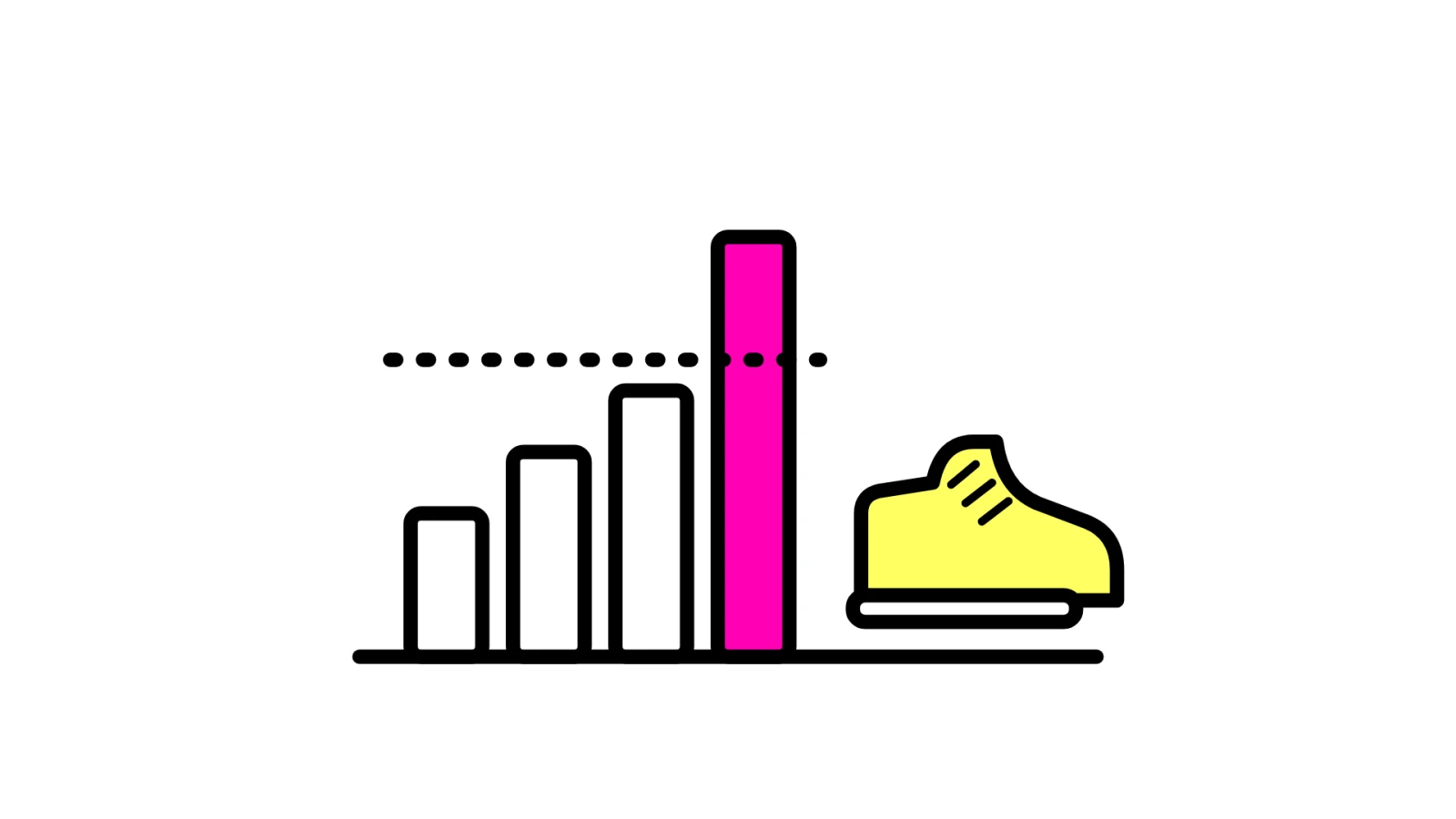
The most important new study on this comes from Denmark: 5,205 runners from 87 countries, 18 months, 588,071 runs recorded with Garmin devices. Each run was compared with the longest run of the previous 30 days (Frandsen et al., 2025):
- run more than 10 to 30 percent longer: injury rate about 1.6 times higher (HRR 1.64)
- more than 30 to 100 percent longer: about 1.5 times (HRR 1.52)
- more than twice as long: about 2.3 times (HRR 2.28)
The week-to-week change in mileage showed no association. In other words, the week is an average. What gets you is often the single spike: the long run on which you feel great and tack on another five kilometres.
To be honest: this is an observational study with self-reported injuries, mostly men around 45. It shows an association, not a cause. The direction matches what I see in coaching, though.
My longest-run rule: before every long run, check your watch or app. What was your longest run in the last month? That's your cap. If it was 15 kilometres, the next one is 16 at most. After a break for illness or holiday, only the last month counts, not the summer.
The 10% rule put to the test
"Never increase your weekly mileage by more than ten percent." Sounds sensible. In a randomised trial with 532 novice runners, one group followed a 13-week plan based on this rule, the other an 8-week standard plan. At the end, 20.8 and 20.3 percent were injured, practically the same (Buist et al., 2008). In another cohort of 874 novices, weekly jumps above 30 percent showed a trend towards more knee and shin problems, but it wasn't statistically clear (Nielsen et al., 2014).
So the rule does no harm, it just promises too much. I use it as a frame for the week and additionally watch two things: the longest run and the morning after.
Easy means easy
According to a widely cited review, competitive endurance athletes do around 80 percent of their sessions at low intensity, the rest mostly hard (Seiler, 2010). Many recreational runners have a different week: every run a bit brisk, none truly slow, none truly hard.
My test: after ten minutes of easy running, say a full sentence out loud. If you can do it without gasping mid-sentence, the pace is right. If only fragments come out, you're too fast. It isn't directly proven that easy running prevents injuries. But it makes the kilometres more digestible and keeps you fresh for the one or two hard sessions a week.
Strength as protection: what's proven and what isn't
This is where it gets interesting. A meta-analysis of 25 studies with 26,610 participants found that strength training cut injury risk to about a third, and overuse injuries almost by half. Stretching showed no effect (Lauersen et al., 2014). But the studies came mostly from team sports and the military. In 720 first-time marathon runners, a short, self-guided strengthening programme did not reduce overuse injuries: 7.1 versus 7.3 percent (Toresdahl et al., 2020).
So for runners, the protection isn't proven. I still prescribe strength training, for two reasons: stronger legs tolerate more, and the effect on running economy is well studied. I do strength training four to six times a week, half of it legs; pull-ups and dips on my bar are the upper-body part. For your running legs, calves, thighs and hips are what count, twice a week, heavy enough that you have one to three reps in reserve.
Calves and tendons: heavy and slow
Your calf absorbs every single step. Up to sprint speeds, the calf muscles provide the largest contribution to support forces in running (Dorn et al., 2012). Tendons adapt mainly to high loads (Bohm et al., 2015). In Achilles tendinopathy, heavy slow resistance training was as effective as classic eccentric training and people stuck with it better: 92 versus 78 percent of sessions (Beyer et al., 2015).
My calf minimum: single-leg calf raises, hand on a wall or bar, three seconds up, three seconds down, once with a straight knee and once with a slightly bent knee. From 15 clean reps, add a backpack. Twice a week after an easy run. For healthy runners this is prevention based on plausibility, not proven by studies.
The pain traffic light: keep running or stop?
I often see two mistakes: grimly pushing through, or cancelling everything at the first twinge. A middle way comes from Achilles rehab, the pain-monitoring model. In a randomised trial with 38 patients, continuing to run and jump under this model did no worse than six weeks of rest (Silbernagel et al., 2007).
- Green: pain during the run at most 5 out of 10, gone by the next morning, not getting worse week to week. Carry on, hold the volume.
- Amber: still noticeable in the morning. Next session easy and shorter, no speed work.
- Red: pain above 5, limping, a spot on the bone that hurts when pressed, pain at rest or at night, swelling. Stop running and get it checked.
The traffic light was studied for the Achilles tendon. For other complaints it's a guide and no substitute for a diagnosis. Personally, I'm stricter than the traffic light today: if my calf or ankle twinges, or I have a slight cough, I stop running immediately. I didn't use to. Often you have to run against your own ego, because when the ego wins, the body always loses in the end.
Sleep and energy: the invisible load
In a survey of 425 recreational runners, poor sleepers reported injuries 1.78 times more often than runners with consistently good sleep (de Jonge & Taris, 2025). It's a survey, so association, not cause. The second invisible load is energy: the 2023 IOC consensus describes how a prolonged mismatch between intake and expenditure can weaken bones and promote stress fractures, among other effects (Mountjoy et al., 2023).
My rule: two bad nights in a row, and the hard session becomes an easy run. Not cancelled, swapped. And if you run a lot and want to lose weight, keep the deficit small and eat enough carbohydrates on long days.
Shoes and stride
Runners who used several pairs in rotation had a roughly 39 percent lower injury risk in a study of 264 recreational runners (Malisoux et al., 2015). Why is unclear, and it's an observational study. If you're buying on Black Friday: a second comfortable pair beats the one dream shoe. A free extra: five to ten percent more steps per minute reduced the load at the knee in the lab (Heiderscheit et al., 2011). No shoe makes up for a run that's too long, though.
The robust week: the framework
My own running week has two hard sessions, one long run and otherwise only easy runs. This is the framework I use to take runners towards higher volumes:
- One or two hard sessions, all other runs at talking pace.
- Long run with a cap: at most a little more than the longest in the last month.
- Two strength sessions for calves, thighs and hips, fixed in the calendar like a run.
- Traffic light after every run, in the evening and the next morning.
- Swap rule: after two bad nights, hard becomes easy.
- Every third or fourth week deliberately lighter.
Points 5 and 6 are coaching practice, not tested as a programme. The full routine is available as a free printable: The Robust Plan: 4 weeks of more running without breaking down (German), with the longest-run rule, pain traffic light and checkboxes. Comment ROBUST under one of my reels on Instagram or send me the word as a DM.
And if you'd rather not build your plan on your own: send me PLAN as a DM on Instagram or book 15 minutes via alethics.de/kontakt. Free, no sales pressure.
This article does not replace medical advice. Alethics does not diagnose. If pain makes you limp, if you have pinpoint bone pain, pain at rest or at night, swelling, cardiovascular disease or signs of low energy availability, get checked by a doctor or physiotherapist. The longest-run rule, swap rule, recovery weeks and calf minimum are coaching practice; the pain traffic light comes from Achilles tendon rehab.
Sources
- Beyer R. et al. (2015). Am J Sports Med 43(7):1704–1711. PMID 26018970
- Bohm S., Mersmann F., Arampatzis A. (2015). Sports Med Open 1:7
- Buist I. et al. (2008). Am J Sports Med 36(1):33–39
- de Jonge J., Taris T. W. (2025). Applied Sciences 15(19):10814
- Dorn T. W., Schache A. G., Pandy M. G. (2012). J Exp Biol 215(11):1944–1956
- Frandsen J. S. B. et al. (2025). Br J Sports Med 59(17):1203–1210. DOI 10.1136/bjsports-2024-109380
- Heiderscheit B. C. et al. (2011). Med Sci Sports Exerc 43(2):296–302. PMC3022995
- Kakouris N., Yener N., Fong D. T. P. (2021). J Sport Health Sci. DOI 10.1016/j.jshs.2021.04.001
- Lauersen J. B., Bertelsen D. M., Andersen L. B. (2014). Br J Sports Med 48(11):871–877. PMID 24100287
- Malisoux L. et al. (2015). Scand J Med Sci Sports 25(1):110–115
- Mountjoy M. et al. (2023). IOC consensus on REDs. Br J Sports Med. DOI 10.1136/bjsports-2023-106994
- Nielsen R. O. et al. (2014). J Orthop Sports Phys Ther 44(10):739–747
- Seiler S. (2010). Int J Sports Physiol Perform 5(3):276–291. PMID 20861519
- Silbernagel K. G. et al. (2007). Am J Sports Med 35(6):897–906
- Toresdahl B. G. et al. (2020). Sports Health. PMID 31642726
- Videbæk S. et al. (2015). Sports Med 45(7):1017–1026. PMC4473093
Keep reading
Personal training · Nutrition coaching · Online coaching · Hamburg & online
More kilometres need a smart plan.
NYNTI, my app, is launching soon. It builds a 90-day plan around your goal and your everyday life, with training and nutrition that fit together, and adjusts it when things go differently. Even when a week doesn't go to plan.