It's 7 pm, it has been dark outside for hours, and the way to the gym feels longer than usual today. For many people, this is the moment in November when strength training quietly pauses until February. The thought behind it: without dumbbells, it doesn't do anything anyway.
The data says otherwise. According to a YouGov survey from September 2026, 19 percent of Germans train on their own at home, while 22 percent are gym members. Of those who train at home, 38 percent use no equipment at all. Training in the living room is normal. The only question is whether it's built in a way that works.
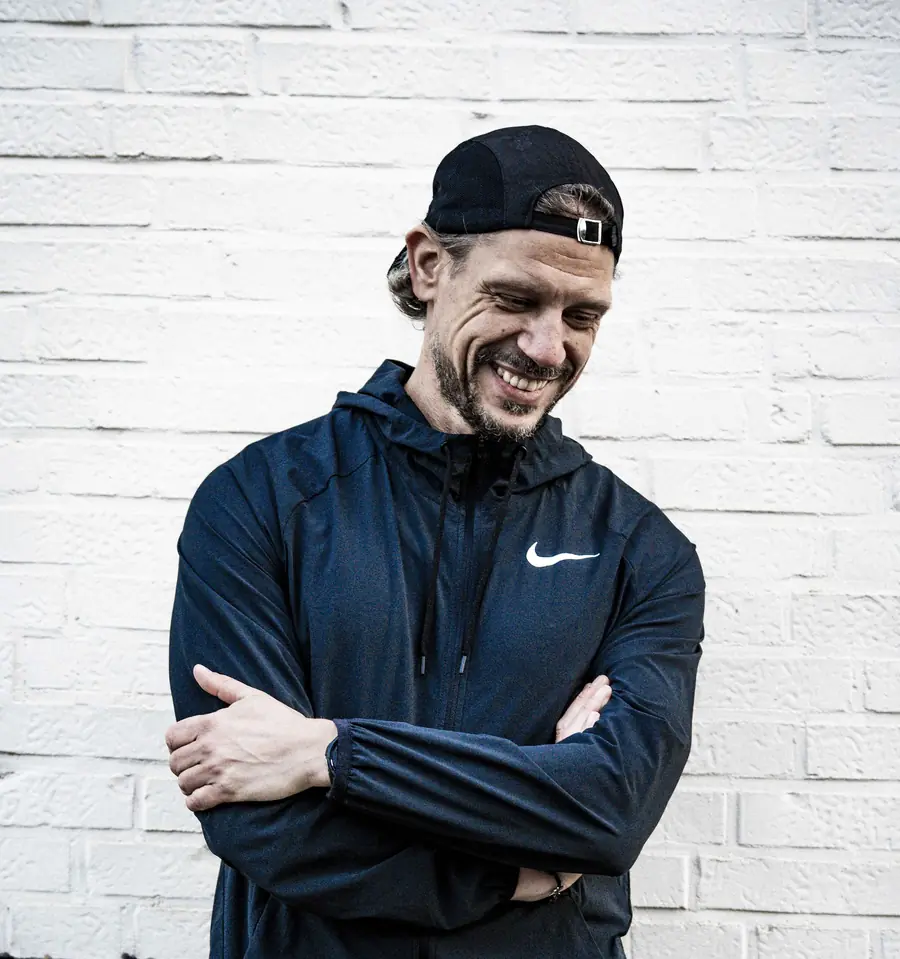
I'm a personal trainer in Hamburg, I run six times a week and do strength training alongside it. When I started in 2023, I signed up for a gym blindly and did something different every day, with no plan and no progression. The place was never my problem, the missing plan was. Here you'll read what research says about bodyweight, bands and everyday loads, how to progress without dumbbells, how to pull at home and what a four-week plan looks like.
Is bodyweight enough for muscle and strength?
Your muscle doesn't know whether a dumbbell is attached or your own body. It responds to effort. A meta-analysis compared light loads up to 60 percent of maximal strength with heavier loads: when sets were taken to failure, muscle growth was similar. Maximal strength increased more with heavy loads (Schoenfeld et al., 2017).
For push-ups there are direct comparisons. 18 young men trained twice a week for eight weeks, either with push-ups or with bench press at about 40 percent of their maximum. Both groups got stronger and built thicker chest and triceps muscles (Kikuchi & Nakazato, 2017). In a second study, 30 trained people did band push-ups or bench press with similar muscle activation for five weeks, with similar strength gains (Calatayud et al., 2015).
The strongest support is the new 2026 position stand of the American College of Sports Medicine, an overview of 137 systematic reviews. It explicitly names bodyweight, bands and home training as effective and found no consistent difference between machines and free weights (Currier et al., 2026). The biggest gain lies in going from nothing to something.
To be honest: the studies on pure bodyweight training are small and short, mostly with young adults. For people aged 30 to 50 the transfer is plausible, but it hasn't been tested directly. And if you want to lift maximally heavy, you'll need heavy weights at some point. For muscle, everyday strength and running, your living room is enough.
How much is enough: two sessions, hard sets
The ACSM recommends training all major muscle groups at least twice a week. For muscle growth it names about ten sets per muscle group per week (Currier et al., 2026). That's a target, not a starting point. For beginners, a review on time-efficient strength training names at least four sets per muscle group per week at six to 15 repetitions (Iversen et al., 2021). With two sessions, that's two hard sets per pattern per session.
At home, the load is usually light. Then what matters is how close a set gets to the end. An analysis of 55 studies found: the closer to muscular failure, the greater the muscle growth, while for strength it hardly mattered across a wide range (Robinson et al., 2024). The ACSM found that training to complete failure does not consistently change results in the average healthy adult. My practical compromise: every set ends when at most one or two clean reps would still be possible.
That gives you a simple rule. If you can do clearly more than 15 clean reps, the exercise is too easy for your set. Then you take the harder variation instead of adding more and more reps.
Progressing without dumbbells: my order
Without progression, every plan stalls. Without dumbbells you progress with five levers, and I use them in this order:
- Reps up to about 15. In a study with 38 trained people, increasing reps brought similar gains to increasing load (Plotkin et al., 2022).
- Tempo: three seconds down, a short pause at the bottom.
- Range: hands on books for push-ups, deeper squats as long as they stay clean.
- Leverage: feet on a chair, one leg instead of two.
- Everyday load: a tightly packed backpack.
In a study with 23 people over four weeks, progressive push-up levels increased bench press strength by 3.4 percent and bench press by 6.52 percent, a difference that was not significant (Kotarsky et al., 2018). Tempo, range and leverage are biomechanically sound but barely studied individually for bodyweight training. The order is coaching practice. The most important part: write down what you managed, otherwise you won't notice when the next level is due.
The four patterns at home
A home programme needs the same four patterns as the gym: legs, push, pull, hips.
Legs: single-leg instead of heavy
A bodyweight squat quickly becomes too easy. On one leg, each leg carries roughly your whole body weight instead of half. In 18 young rugby players over five weeks, the Bulgarian split squat and the back squat were equally effective for lower-body strength, sprint and change of direction (Speirs et al., 2016). This suits runners especially well, because running means supporting yourself on one leg.
How to do it: chair against the wall, back foot on the seat, lower slowly until your back knee almost touches the floor. Too easy: slower, pause at the bottom, backpack in front of your chest. If your knee hurts, shorten the range and get it checked.
Push: the push-up ladder
The higher your hands, the easier: wall, kitchen counter, chair, floor, feet elevated. Your level is the one where six to 15 clean reps are possible. I deliberately don't give body weight percentages, they vary with build and posture. Body like a plank, elbows slightly back, chest to just above the edge or floor.
Pull: the gap in home training
Push-ups and squats work anywhere, pulling needs something to hold on to. That's why it's missing from most home programmes. The best option is often the table row under a heavy, stable table. In a biomechanics study, this exercise showed the highest activation of the lats and upper back and the lowest load on the lower spine among the rowing variations tested (Fenwick, Brown & McGill, 2009). It isn't a training study.
Check first whether the table tips when you pull on the edge. If it does: don't. Alternatives are a band on a secure anchor point or a one-arm backpack row, supported on a chair. Never hang your body weight on a door handle or door frame. My rule: at least as many sets of pulling as pushing.
Hips and posterior chain: the sofa as a bench
Shoulders against the edge of the sofa, feet flat, hips up, hold for two seconds at the top: that's the hip thrust at home. In a nine-week study, hip thrusts and squats produced similar glute growth and similar transfer to the deadlift (Plotkin et al., 2023). For your hamstrings, hold the backpack against your chest and hinge forward from the hips with a long back. If it gets easy: single-leg and slower. If your back twinges, make the movement smaller.
Backpack, water, band: before your Black Week purchase
At the end of November, deals on dumbbells, benches and weighted vests are everywhere. Before you buy, pack your backpack. Six full 1.5-litre bottles weigh about nine kilos, because a litre of water weighs about a kilo. Add a few books and you have a load for squats, rows and hips. Pack it tightly, plastic instead of glass, hip belt closed.
If that becomes too easy, a set of bands is the first thing worth buying. In a meta-analysis of eight studies, elastic resistance produced similar strength gains to conventional weights (Lopes et al., 2019). Then a securely mounted pull-up bar, and only then dumbbells. That's my order, not a brand recommendation.
20 minutes: the short session
Twenty minutes are enough if they're built well. Three minutes to warm up, then two pairs in alternation: legs with rows, push with hips. While one muscle works, the other recovers. Supersets and full-body sessions are considered time-saving strategies (Iversen et al., 2021). Twice a week, these 20 minutes cover the four sets per muscle group for beginners.
Short bursts of up to one minute spread over the day, so-called exercise snacks, help fitness but, according to the review, don't replace strength training (Islam, Gibala & Little, 2022). For runners, the session belongs on an easy running day and not before intervals.
Your 4-week plan for home
- Week 1, the test: for each pattern, find the level with six to 15 clean reps and write the number down.
- Two fixed appointments per week, with a time, as an if-then sentence: "If Tuesday evening, then living room." Such plans show a medium to large effect on reaching goals across many studies (Gollwitzer & Sheeran, 2006).
- Two hard sets per pattern, each ending with zero to two reps in reserve.
- Progress every week: one more rep or the next level.
- Week 4, the second test. If a session falls through, you don't make it up. You just carry on.
In four weeks you'll mainly see gains in strength and technique. In Kotarsky's push-up study, no increase in muscle thickness was measurable after four weeks. Visible muscle growth takes longer. But after four weeks you'll know in black and white what your living room can do.
You can get the whole plan with levels, progression rules and tick boxes to print out: comment WOHNZIMMER (German for "living room") under one of my Reels or carousels on Instagram or send me the word as a DM (the plan is in German), and you'll get Das Wohnzimmer-Programm (The living room programme: 4 weeks of strength without a gym) for free.
And if you'd rather not build your plan alone: send me PLAN as a DM on Instagram or book 15 minutes via alethics.de/en/contact. Free, no sales pressure.
This article does not replace medical advice. Alethics does not diagnose. If you have pain, cardiovascular disease, are pregnant or recovering from an injury, get medical clearance before starting. The progression order, push-up ladder, 20-minute session and 4-week plan are coaching practice, not tested as a programme; the studies are mostly small, short and done with young adults. Check improvised equipment (table, chair, backpack) for stability before every use.
Sources
- Calatayud J. et al. (2015). J Strength Cond Res 29(1):246–253. PMID 24983847
- Currier B. S. et al. (2026). ACSM position stand on resistance training. Med Sci Sports Exerc 58(4):851–872. DOI 10.1249/MSS.0000000000003897 (key statements checked via ACSM infographic and press release)
- Fenwick C. M. J., Brown S. H. M., McGill S. M. (2009). J Strength Cond Res 23(2):350–358. PMID 19197209
- Gollwitzer P. M., Sheeran P. (2006). Adv Exp Soc Psychol 38:69–119. DOI 10.1016/S0065-2601(06)38002-1
- Islam H., Gibala M. J., Little J. P. (2022). Exerc Sport Sci Rev 50(1):31–37. PMID 34669625
- Iversen V. M. et al. (2021). Sports Med 51(10):2079–2095. PMID 34125411
- Kikuchi N., Nakazato K. (2017). J Exerc Sci Fit 15(1):37–42. PMID 29541130
- Kotarsky C. J. et al. (2018). J Strength Cond Res 32(3):651–659. PMID 29466268
- Lopes J. S. S. et al. (2019). SAGE Open Med 7. DOI 10.1177/2050312119831116
- Plotkin D. et al. (2022). PeerJ 10:e14142. PMID 36199287
- Plotkin D. L. et al. (2023). Front Physiol 14:1279170
- Robinson Z. P. et al. (2024). Sports Med 54(9):2209–2231. DOI 10.1007/s40279-024-02069-2
- Schoenfeld B. J. et al. (2017). J Strength Cond Res 31(12):3508–3523. PMID 28834797
- Speirs D. E. et al. (2016). J Strength Cond Res 30(2):386–392
- YouGov Germany (09.09.2026). Survey on fitness training (sample size not stated in the publication)
Keep reading
- Christmas parties, restaurants, buffets: how a former chef eats through the season
- The winter block after a marathon
- Losing weight while you train
Personal training · Nutrition coaching · Online coaching · Hamburg & online
Your training doesn't need a place, it needs a plan.
NYNTI, my app, is launching soon. It builds a 90-day plan around your goal and your everyday life, with training and nutrition that fit together, and adjusts it when things go differently. Even when the gym isn't happening this week.